| < Previous Page The Next Frontier of Innovation 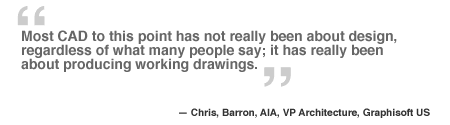
CB. If we can model a building we can improve it. If we can really simulate what it's going to look like when we walk through it, what the sounds are going to be like when you are sitting in an auditorium, what the implications of the materials and the cost are...I think that is really the next phase of innovations. Most CAD to this point has not really been about design, regardless of what many people say; it has really been about producing working drawings. And I think we (Graphisoft) have that handled really well. The next frontier is really to make the computer a real design companion for architects. AFR. Along those same lines, some of your competitors like Autodesk are coming up with 'electronic sketching tools' and tools like SketchUp—these more naturalistic computer tools which are supposed to simulate the architect's more traditional drawing methods. What is Graphisoft doing to address that front? CB. Well I think you will see some things later on in the year that will address that specifically...not just turning a sketch into a model but in the modeling environment which will give you more tools to do those types of things. I think there is a danger when you take the computer and try to turn it into a sketch pad. I think that part of the challenge, taking the type of environment where the architect is familiar with and trying to imagine where that environment can be with computer technology, is where Graphisoft wants to be. It is more than just sketching. But you know, I love SketchUp, I think it is a great product. The nice thing is if you can take that more sketchy model and bring it into a more architectural modeling program like ArchiCAD. There is a benefit there. AFR. Speaking of sketching and the like, a lot of architects now are walking around with Palm Pilots and other PDA or smart devices and so forth....and there seems to be a push to get CAD data on these small devices. Will Graphisoft be addressing that front? CB. You know I actually don't know if we have anything yet planned for a handheld computer. I think a lot of that is being taken care of by the hardware itself. Today what I can do on a laptop would have weighed about eighty pounds ten years ago. AFR. So your users are not asking for that kind of a product? The PDA CAD solution? CB. No. Not yet. There are certain areas with the facilities management where that functionality is needed, but for the designer they want to sit down and have both hands free. Market Focus - Market Forces 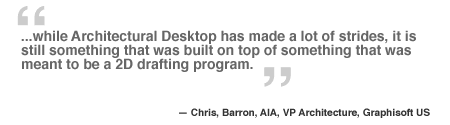
AFR. Sure. Let's talk a little bit about your userbase. I know you guys are grabbing a lot more users. For example, in a Boston area an architects' survey ArchiCAD had about fifteen percent (15%) of the market, whereas Autocad was down to just 49 percent (49%). Is Graphisoft targeting Autocad users directly...going directly after Autodesk? CB. Absolutely. For a number of reasons. One, Autocad has gotten as good as it's going to get in terms of drafting. There just aren't too many more ways to draw an arc. AFR. Makes sense. I completely agree with you there. CB. And, quite frankly, they have in the US, a dominant marketshare. So most users are going to be coming over from Autocad. We like to say 80 percent of ArchiCAD users are ex-Autocad users. AFR. Is that true? CB. (laughter...) Yea! when you stop to think about it it is not at all that surprising. Quite frankly, while Architectural Desktop has made a lot of strides, it is still something that was built on top of something that was meant to be a 2D drafting program. It doesn't have the type of system architecture you need to have to do real 3D, architectural [intelligent] modeling. And so we would like to be in a situation where we are competing head-to-head with Architectural Desktop because it would become very clear to someone who is comparing them side-by-side that one is just much less cumbersome, much more designed for its purpose. The other side to this is that throughout the 90's people were very busy and didn't have the time to learn, or just stop and evaluate a new CAD program...but things are changing a bit now. There isn't that backlog of work maybe...and they realize now is the time to sit down and do an evaluation. They know 3D is coming and they now have the time to be interested. AFR. That makes a lot of sense. I talk to many folks regularly and it is true, they get too busy and they literally do not have the time to learn a new system and that is definitely a challenge for utilizing new software during a boom period. AFR. In terms of an approach to persuading an Autocad user, what is your angle? CB. I think there are two things. One we talk about the productivity. There is a quote from one of our customers-Orcutt Winslow Partnership, who have about 65 Macintoshes using ArchiCAD in Phoenix-and they said, "by the time I'm done with design development my construction documents are about 60 percent complete". And that really gets to the real advantage of model-based design inherent in ArchiCAD. The construction documents are almost bi-products [of the model]. So there is tremendous productivity there. And then the other things is that when you have a lot of people drafting with Autocad, you usually have a lot of designers designing and then you have the production crew drafting on Autocad. With ArchiCAD it's is a different situation. The people doing the designing are working with the product. You know, the thing I like about ArchiCAD is it just puts the fun back into design. Designers can design up to the last minute, they can revise the design in the model and not just think of it as a marketing tool. So the two things we really push in our marketing to Autocad users is the enhanced productivity and the fun. AFR. I want to talk a little about your users. Do you know if many of your ArchiCAD users on the Mac are migrating to Windows or vice versa perhaps? | 1 | 2 | 3 | 4 | 
|