- AFR - Anthony Frausto-Robledo, Editor
- Dom - Dominic Pedulla, Associate
- Jim - Jim Highum, AIA, Associate
- David - David Caruso, Director of Information Technology
 AFR How long has Flansburgh Associates Inc. been in existence? Jim Since 1963. It was founded by Earl Flansburgh, originally in Cambridge, Massachusetts. AFR Has the firm always focused on educational work? Jim Yes, in the early years the office had a wider selection of building types, but today we are primarily focused on educational projects of all types; we have done numerous master plans abroad, for both educational and urban conditions. While we have done a broad range of building types we have always had an emphasis on educational projects. 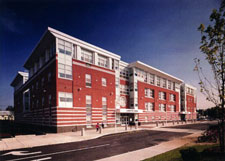
AFR Have you found that technology over the last decade is driving school work? Is technology a major factor? Jim Are you asking if technology generates a school board to come forward and build? AFR Sure. Jim The decision to build is usually generated by many years of deferred maintenance and over crowding. The towns know that if they build a school they will get up-to-date technology, but they don't build the school primarily to get the technology. 
Dom There is a technology component that goes along with public state funding, but it is not the only driving factor for building new schools. The dollar value allocated is a number that fluctuates around $1200 to $1600 per student for computer/technology use. In addition we typically have specific classrooms designated as computer labs, and the "library" has been redefined as a Media Center with 15 to 20 computer stations for research use. Technology can be a factor on how teachers teach...in one community we have "linked" three schools to share and gather information, and possibly teach from a remote location. Technology is starting to influence and reflect how teachers at the public sector can teach. It is a tremendous tool but it is also a tool that is short lived and expensive to replace. Jim This technology funding is over and above what they used to pay for school construction. So that's a change in the past couple of years. AFR When you are working with the schools and meeting with the principals, teachers, superintendents and so fourth discussions about computer infrastructure and wireless IT part of the early-design planning process? Dom Absolutely, this question is always discussed. Some communities see the advantages and flexibility's of wireless and really push for it, but they ultimately have a limited budget determined by state formulas. AFR Are you advocates of wireless technology like Apple's AirPort technology? Jim Determining the best technology is sort of a back and forth process. We interview the client to find out what they want and then we come back and suggest to them what will meet their needs. We use some very good technology consultants to work out the details, to determine what is the state-of-the-art on the market at that time. We are constantly updating that. AFR What educational consultant do you use for IT technology? Continue article - top right column > | | 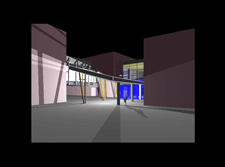
Jim The technology experts we use are not actually educational consultants, but we always make sure they have a background in educational facilities. The final selection is made by our clients. 
AFR In the interview process and the process of being selected as architects are you using computer technology to seduce the prospective client? Dom I would not say "seduce" the client but the computer is our design tool. We have designers that are very passionate about design, and the interview process, and are able to use our Mac-based software—like Adobe Illustrator, Photoshop, and Form-Z to produce very sophisticated presentations. The boards can become works of art, but is not meant to be a "a seduction", but rather an expression of an idea from an architect. AFR So are you producing your graphics on boards, not using projector base presentations? Jim That is actually taking off a great deal. We are doing far more PowerPoint presentations now. We are upgrading our graphics capabilities because the client expectations are getting more sophisticated. Every interview we go to there is something new in our presentation, so this has been the biggest year for change in terms of the quality of the boards and the PowerPoint presentations. AFR Can you give me an example of how your presentation has changed in the past year? 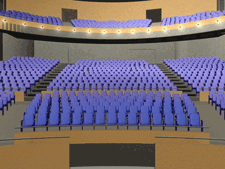
David In December we brought in a new graphic designer to do more three dimensional models...things we hadn't done before. And I know for two or three projects he has provided walk-throughs and more advanced 3D view still images. AFR Are you saying that the Design Team is engaged in 3D modeling from the beginning? Dom We have numerous designers that generate 3D modeling from the very beginning of a project, while others are more comfortable generating hand drawings over a simple computer wire-frame. The images we present to our clients are a key tool for them to understand the process of designing a building...and we have found that crisp line computer drawings at an early phase look "too finished" too early. In all cases, at the early stages, the 3D modeling is usually a beneficial tool for us to understand the complexities of the projects; later on in the design process it becomes a tool for the client to "walk-through" the designed structure. 
Jim It has a double benefit. We are getting early massing studies for design solutions, and the client understands 3D images a bit better than elevations and plans. AFR What other 3D or CAD programs do you use here at Flansburgh? David We use Form-Z for modeling and rendering, Electric Image for animation fly-throughs and rendering, and VectorWorks for CAD. Using VectorWorks our staff has the ability to generate 3D models easily from the 2D plans, so they don't necessarily have to be 3D savvy users. We leave Form-Z for the more advanced 3D work due to its higher learning curve. 
|