|
<
Previous Page
CB. It was more strategic. Part of it was wanting
to demonstrate our ongoing commitment to Apple's Mac
OS platform. And when one out of every two customers is
a Mac user it's kind of important to be early.
Our principal motivation was to show our commitment, that
the Mac is an important platform and that we would be there
for our customers.
AFR. Did Graphisoft feel that with OS X being a UNIX-based
system that perhaps there was even more of a reason to support
Mac OS X?
CB. Well, I think that it will make it an easier support,
a more robust operating system and as OS X continues to develop
there will be some noticeable performance reasons. The development
process was pretty straight forward for us and was not a horrendous
effort.
AFR. I think there has been a lot of comments about
Linux, especially in the
last week, with the Linux conferences, about Pixar
and Dreamworks switching to the Linux platform...and just
the highend 3D market's interest in Linux over proprietary
UNIX OS's. So it seems that it is only a matter of time before
Linux lands on the architect's desktop. Is there any discussion
at Graphisoft about that?
CB. Yeah. I don't necessarily think that it is part
of our product plans-though we are always looking at product
trends-I mean any more than UNIX has been a major factor on
the architectural desktop. It is one thing for Pixar where
they are really doing highend stuff and they have never really
been involved [users of] with the mass operating systems like
Mac or Windows.
We will look at what our customers want. We won't do it just
to do it.
AFR. With new 3D architectural CAD products like Revit
and BOA coming on
the scene, they seem to be validating Graphisoft's original
CAD thesis about the "virtual building" paradigm.
But how is Graphisoft going to compete with these newcomers
in the future since they seem to be offering the same CAD
promises and paradigm as ArchiCAD but at a much lower price
point?
CB. Well, I'm not really familiar with BOA yet, but
with Revit's pricing model I don't think it has been one that
is very successful. There is a real problem with an architect
operating a mission critical piece of software like CAD and
if they can't make their payment their tools go away. That's
just bad-it doesn't work.
The architectural business is very cyclical, can go very
up and down, so it is important for architects to own their
software tools.
AFR. No, you raise a very good point. The AEC business
can be very uneven even in the middle of an economic cycle.
CB. I think for some customers the price is the overarching
issue. But for most because this is the tool of their trade,
they don't want to buy a cut-rate tool. My challenge is to
provide enough benefit and value so it is worth the cost.
AFR. I guess one of the things I continue to think
about is that with sophisticated CAD products like yours where
there is a continuous increase in new functionality, isn't
that pushing your product more up-market? And if so doesn't
that require a larger revenue base or more margin thus driving
the price up?
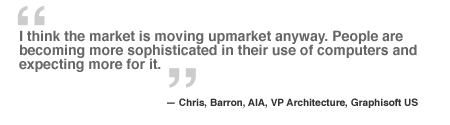
CB. No. I think the market is moving upmarket anyway.
People are becoming more sophisticated in their use of computers
and expecting more for it. And we are not raising the price
of ArchiCAD...in fact we just lowered the price of the first
seat.
AFR. How has the Mac Graphisoft userbase reacted to
the new OS X version of ArchiCAD?
CB. I would say that it is a little early to say.
They really like the implementation in terms of the user interface
(UI). We had to wait to 10.1 because there were some issues
in respect to printing and so forth. And also because architects
don't rush out and upgrade to new software generally. Especially
with an upgrade to a new operating system and then to put
on top of that a new CAD system.
There tends to be a slower adoption. But the initial reports
have tended to be positive. And we will continue to improve
it and take advantage of some of the performance features
there.
AFR. How as Apple been as a developer to work with?
CB. You know I can't say directly because the development
takes place in Budapest, but as you know we came out virtually
simultaneously with OS X and Windows XP and I would say Apple
must have done a pretty good job to support us, to make that
happen.
AFR. In terms of that peripheral of software products
built around ArchiCAD, have you seen a lot of support there
with OS X so that ArchiCAD users on the Mac can come over
to OS X?
CB. Umm...That's a good question. Those products that
have always enjoyed a substantial part of their userbase on
Macintosh—like Art-lantis—you can be pretty sure
they will be on OS X soon. And for those products, since they
run inside of Graphisoft or are connected, they had to wait
until we were over on OS X. It's a two step process.
AFR. Sure.
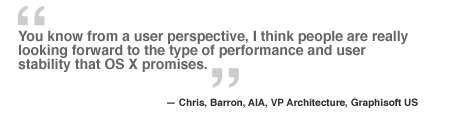
CB. You know from a user perspective, I think people
are really looking forward to the type of performance and
user stability that OS X promises.
AFR. Right, well certainly from the point of view
stability the operating system (OS X) is....(laughter) light-years
ahead of where the old Mac was -- and even ahead of where
Windows is today in my opinion. But we'll just have to see
how that plays itself out.
AFR. You mentioned Artlantis and I wanted to ask you
a little bit about modeling and 3D because a lot of action
in the studios in architecture schools, both here and around
the world, is taking place with more advanced tools, like
Alias's Maya, Lightwave 3D and others...students are obviously
encouraged to be inventive and they have their heroes like
Frank Gehry and so forth and they are trying to do some really
cutting edge stuff.
Are more advanced 3D modeling functions planned for ArchiCAD
to get beyond the normal box-functions that make up traditional
buildings?
CB. Yes they are. And some of these things will be
incorporated into the next version which will probably come
out towards the end of the year. There is a difference between
completely free-form design...and Frank Gehry is certainly
at the cutting edge. I think he actually uses CATIA and can
go straight from model to manufacturing...but certainly...in
architectural design today there is much more interest in
being able to do a more freeform And where we try to be is
to maintain the balance between predefining certain types
of objects and giving the architect the tools he needs to
easily construct custom ones.
Some of the tools you just mentioned tend to be a little
too expensive for most architects...and that is the other
problem we are trying to work with: looking at the tools which
most architects want to use and can afford and try to respond
to that.
AFR. Is Graphisoft still motivated to partner with
companies that provide advanced rendering technology or is
Graphisoft thinking of providing those technologies inside
ArchiCAD?
CB. Well...we want to focus on what we do best. And
we have had a long and very good relationship with Artlantis
and of course some others—you mentioned ExpressionTools
(ETShade)—so, yes, we would like to focus on our area
of expertise and while we have some rendering technology built
into ArchiCAD, we really want to focus on building the model
and getting the drawings out.
AFR. Well Chris I want thank you for talking to Architosh
about ArchiCAD and Graphisoft's future with architectural
CAD and facilities management products. It's been a very interesting
discussion and I wish Graphisoft the best.
Chris. Sure. Thank you.
Christopher
L. Barron, AIA, is the Vice President of Architecture
for Graphisoft US, Inc., the makers of ArchiCAD, a 3D architectural
CAD solution. He received his Masters of Architecture degree
from Harvard University, and was a building architect for
The Architects Collaborative (TAC) in Cambridge, Massachusetts.
Mr. Barron has been involved in the field of architectural
CAD for 18 years and had worked for Intergraph, Softdesk,
and Autodesk before joining Graphisoft in 2001. He is a Fellow
of the Design Futures Council and has published several articles
on the topic of architectural CAD.
Anthony
Frausto-Robledo, B.Arch., is the founder and editor of the award-winning
Architosh.com Web site. Educated as an architect,
he has been an architectural professional for over 17 years and was a senior
designer with the distinguished Boston architectural firm Koetter
Kim & Associates prior to launching his web consultancy, BritasMedia.
As president of BritasMedia, Anthony consults AEC firms on strategic Web initiatives,
animation, databases, and IT-related issues in addition to publishing the Architosh
site daily. Since 1997 he has been a member of the Thesis Studio and History
& Theory faculty at the Boston Architectural
Center College of Architecture and Interior Design and a Thesis Advisor.
BritasMedia's
publishing mission with the Architosh Website is to serve a worldwide audience
of Macintosh-based CAD/3D and AEC professionals with market-leading information
technology (IT) resources, news and editorial products. Architosh currently
serves over 25,000 readers monthly in more than 70 countries around the world.
| 1
| 2 | 3
| 4 |
|